
Download Hopsworks – AI Lakehouse Platform for Secure, Scalable Data & Model Management
Overview of Hopsworks
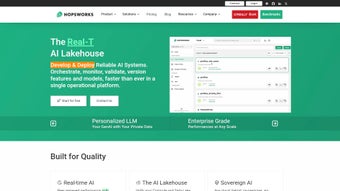
Hopsworks is an AI‑focused lakehouse platform that unifies data engineering, feature management, and model serving into a single, secure environment. Designed for modern data‑driven organizations, it delivers a robust Feature Store that captures the entire lifecycle of AI features—from creation and versioning to real‑time serving—while preserving full lineage and governance. The platform’s modular architecture allows seamless integration with existing pipelines built on Spark, Flink, or Kubernetes, and it works equally well with on‑premise, SaaS, or multi‑cloud deployments across AWS, Azure, and Google Cloud.
Whether you are developing fraud‑detection models, recommendation engines, or large‑scale predictive analytics, Hopsworks provides the tools to turn raw data into production‑ready insights without sacrificing security or compliance. Its open‑source Community Edition offers a cost‑effective entry point, while the enterprise tier adds advanced monitoring, multi‑tenant isolation, and premium support. In essence, Hopsworks serves as a full‑stack AI lakehouse that empowers data scientists, engineers, and business analysts to collaborate efficiently, accelerate time‑to‑value, and maintain rigorous data governance standards.
Key Features and Installation Options
Feature Highlights
- Unified Feature Store: Central repository with version control, lineage tracking, and online/offline serving.
- End‑to‑End Lakehouse: Combines data warehousing, lake storage, and AI tooling to eliminate data silos.
- Modular Architecture: Plug‑and‑play components integrate with Spark, Flink, Kubernetes, TensorFlow, PyTorch, and Scikit‑Learn.
- Multi‑Deployment Flexibility: Available as on‑prem Docker/Helm, fully managed SaaS, or cloud‑native images for AWS, Azure, and GCP.
- Governance & Auditing: Role‑based access control, GDPR‑compliant handling, and detailed audit logs.
- Real‑Time Analytics: Low‑latency streaming pipelines for instant feature retrieval.
- Extensive APIs & SDKs: REST, Python, Java, and Scala interfaces for programmatic access.
- Open Standards Compatibility: Supports Parquet, ORC, Avro, CSV and integrates with Airflow, Dagster, Prefect.
- Built‑In Model Registry: Versioned model storage linked directly to feature versions.
- Security First: Encryption at rest/in‑transit, secret management, ISO 27001 & SOC 2 certifications.
Installation Pathways
Hopsworks offers three primary ways to get started. For on‑premise teams, a Docker‑Compose script or Helm chart can spin up the full stack on any Linux server with at least 8 CPU cores, 32 GB RAM, and 500 GB storage. Cloud‑native users can launch pre‑built AMIs on AWS, Marketplace images on Azure, or Deployment Manager templates on GCP, each provisioning a Kubernetes cluster with Hopsworks pre‑installed and integrated with native IAM, VPC, and load‑balancing services. For organizations that prefer to avoid infrastructure management altogether, the SaaS option provides a free trial tenant that scales automatically, includes nightly backups, and receives continuous security patches. Regardless of the chosen pathway, the installer guides you through configuring HopsFS (the distributed file system), setting up the web UI, and creating your first feature group, ensuring a smooth onboarding experience.
Usage Workflow, Compatibility, and Frequently Asked Questions
Typical Usage Workflow
After installation, users follow a straightforward pipeline. First, data is ingested from databases, streaming platforms, or file stores using built‑in connectors or custom Spark jobs. Next, feature engineers define feature groups in the UI or via the Python SDK, applying transformations and scheduling batch jobs.
Each feature group is automatically versioned, and lineage metadata is captured for auditability. Data scientists then pull these features directly into Jupyter or Zeppelin notebooks for model training, using any framework they prefer. Once a model is trained, it is registered in the Hopsworks Model Registry, where it is linked to the exact feature versions used during training.
The model can be deployed to an online endpoint, and the Feature Store supplies low‑latency feature values for real‑time inference. Finally, monitoring alerts detect data drift or performance decay, triggering automated retraining pipelines that close the feedback loop.
Operating System Compatibility
Hopsworks runs on any modern Linux distribution (Ubuntu 20.04+, CentOS 8+, Debian 11+) via Docker or Kubernetes. The SaaS and cloud‑native options abstract the underlying OS, allowing users to interact through a web browser on Windows, macOS, or Linux. All client SDKs (Python, Java, Scala) are cross‑platform, ensuring developers can work from their preferred workstation without compatibility concerns.
Frequently Asked Questions
Is Hopsworks free to use?
Hopsworks offers an open‑source Community Edition that can be downloaded and run at no cost. Enterprise‑grade features such as managed SaaS, advanced security controls, and dedicated support require a paid subscription.
Can Hopsworks integrate with existing Hadoop clusters?
Yes. Hopsworks was originally built on top of Hadoop and can connect to existing HDFS or HopsFS storage layers, allowing you to extend legacy clusters with modern feature‑store capabilities.
How does Hopsworks ensure data security and compliance?
The platform provides encryption at rest and in transit, role‑based access control, detailed audit logging, and supports GDPR, ISO 27001, and SOC 2 compliance. Secret management integrates with HashiCorp Vault and cloud‑native key management services.
Which machine‑learning frameworks are supported?
Hopsworks works natively with TensorFlow, PyTorch, Scikit‑Learn, XGBoost, LightGBM, and any framework that can access the Feature Store via its Python, Java, or REST APIs. ONNX models are also supported for cross‑framework deployment.
Is there a fully managed cloud service for Hopsworks?
Yes. Hopsworks Cloud delivers a fully managed, auto‑scaling service on AWS, Azure, and GCP. The SaaS version removes the operational burden while providing the same feature‑store and lakehouse capabilities.
Conclusion & Call to Action
Hopsworks stands out as a comprehensive, enterprise‑ready AI lakehouse that bridges raw data and production‑grade machine‑learning models. Its unified Feature Store, modular architecture, and flexible deployment options make it a compelling choice for organizations aiming to accelerate AI initiatives while maintaining strict governance and security. Although the initial setup may require some Kubernetes expertise, the long‑term productivity gains, scalability, and model reliability far outweigh the learning curve. Whether you are a startup building its first recommendation engine or a large corporation modernizing a legacy data stack, Hopsworks equips you with the tools to turn data into actionable intelligence.
Ready to experience a secure, scalable AI lakehouse? Download Hopsworks today and start building production‑ready features and models in minutes. For enterprises seeking to eliminate infrastructure overhead, explore the managed SaaS offering and focus solely on innovation.